
Mark Forkgen
Music Director
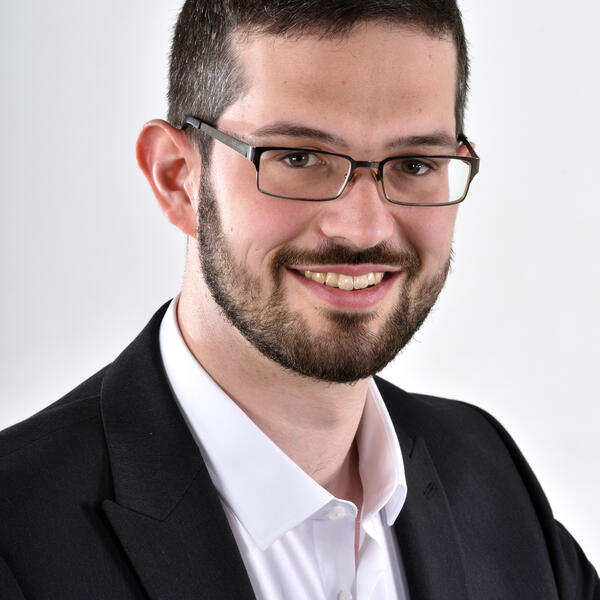
Martyn Noble
Organist, Piano, Principal Accompanist
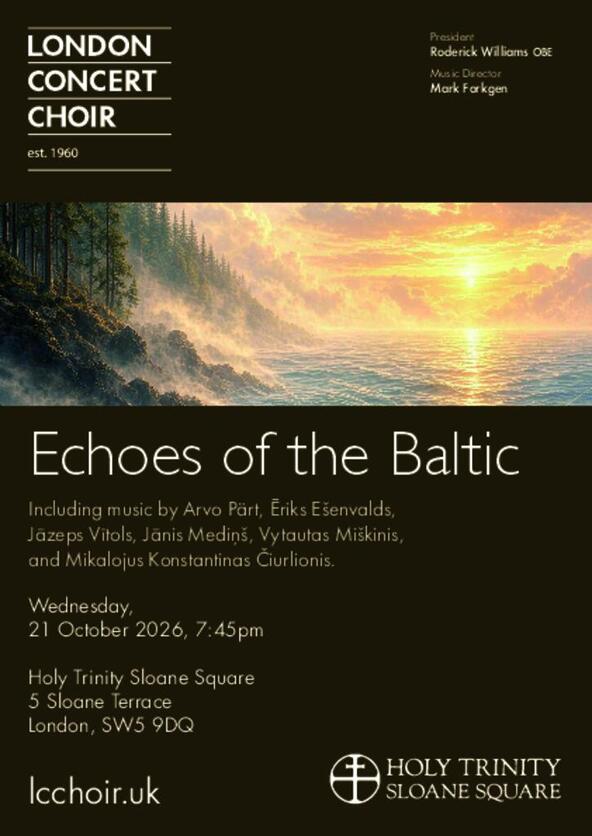
Echoes of the Baltic brings together sacred, folk and concert music from Estonia, Latvia and Lithuania, three neighbouring traditions bound by choir, stillness, landscape and light.
The evening is anchored in Estonia by Arvo Pärt. His Berliner Messe (Berlin Mass), written for the 1990 German Catholic Congress in a newly reunited Berlin, is a central work of his tintinnabuli style: spare lines, bell-like triads and a chant-like calm. Beside it stands The Beatitudes, his English setting of the Sermon on the Mount, another piece of radical simplicity, in which blessing is heard as much in rest as in melody.
From Latvia come two different choral worlds. Ēriks Ešenvalds’s The Heavens’ Flock is typical of his luminous writing: voices as sky and constellation. Jāzeps Vītols’s Gaismas pils (Castle of Light, 1899) is a national-romantic ballad on verses by Auseklis and a cornerstone of the Latvian Song Festival. Its “castle” is not a building but a buried source of light and language.
A piano solo from Jānis Mediņš’s 24 Dainas (1921-62) turns from choir to keyboard. Named after the Latvian folk daina, these short preludes absorb its speech-rhythms and concentrated feeling rather than quoting folksong outright.
Lithuania is heard in two living choral voices and in its most visionary artist-composer. Vytautas Miškinis’s Pater Noster is a contemporary Lord’s Prayer, clear and unsentimental. Vaclovas Augustinas’s Trepute Martela draws on folk dance and song. An organ solo, Mikalojus Konstantinas Čiurlionis’s Fugue in C-sharp minor (c.1899), belongs to the same mind that painted cosmic landscapes: even in counterpoint he thinks in colour and space.
Together the works move from mass and beatitude to flock, castle, folk-poem, prayer, dance and fugue, a single shoreline heard in three languages.
 Download Concert Flyer (1.22 MB)