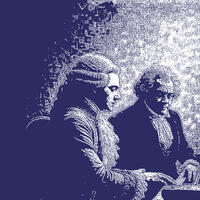
The Vesperae solennes de Confessore is one of two settings Mozart composed for the vespers, an element of Christian worship used in the Catholic, Anglican and Eastern Orthodox traditions.
The work was written during the second of his appointments to the court of Prince-Archbishop Hieronymus Colloredo in Salzburg, Mozart’s birthplace. From 1772, he had held the post of Konzertmeister, or leader of the orchestra, and, while producing numerous compositions for the court, he frequently stayed away from Salzburg, seeking to establish his reputation with performances of his secular works in Augsburg, Mannheim, Milan and Paris. When offered the more senior post of Kappellmeister, or court organist, in 1779, Mozart accepted, but maintained his ambitions for a career beyond Salzburg. It was against this backdrop that he composed his two settings of the vespers: Vesperae solennes de Dominica in 1779, which was intended for Sunday services, and the Vesperae solennes de Confessore in 1780 (thought to be subtitled “for a saint’s day” by someone other than Mozart. “Confessor” refers to a saint who died a natural death rather than being martyred for their faith).
The 1780 setting, performed at tonight’s concert, was to be his final sacred composition for Prince Colloredo, with whom his working relationship had become increasingly fractious. The social conventions of courtly service had placed constraints on Mozart’s time (although by his own admission he only attended the court when expressly requested). At the same time, the cathedral’s formal requirements for liturgical works, such as the manner of setting the text and the forces available for performance, limited his musical freedom.
Mozart’s response to these frustrations was to pursue artistic independence and recognition elsewhere, taking extended leave from his cathedral duties to present his opera Idomeneo in Munich, among other distractions. While the prince was infuriated by Mozart’s absences, the composer felt his modest status at court demeaning. In summer of 1781, these tensions gave way to open hostility. Mozart tendered his resignation on several occasions until it was accepted, and the Salzburg period of his career came to an end.
Although Mozart chafed against the expectations associated with his appointment at Salzburg Cathedral, he nonetheless committed seriously to the composition of his sacred works, and they can be regarded as expressions of faith. The Vespers offer an opportunity to set some of the most significant liturgical texts other than the Mass, which for the most part he approached in the traditional, contained stile antico required at Salzburg rather than expanding into arias and instrumental writing. This involves interweaving the solo and choral textures, and a string section without violas.
“Vespers” describes the evening prayer service offered in preparation for the celebration of the Eucharist, or Holy Communion. This custom forms part of the Liturgy of the Hours, or Divine Office: a cycle of prayer throughout the day. The Vespers focus on praise and thanksgiving and follow a prescribed selection of psalms. These are followed by a canticle, or song from scripture; in this case, the Magnificat, Mary’s prayer of praise and acceptance in response to the Anunciation. Each prayer concludes with the trinitarian doxology (Gloria Patri).
Mozart sets the psalms with sparkle and vigour, with scoring that is sometimes descriptive of the subject, such as the triumphant Dixit in the opening movement or the timorous ascending runs in Beatus vir of the third movement; and at other times counterintuitive to the meaning of the text, as in the serious, almost threatening tone of the Laudate pueri in the fourth movement. In contrast to the often robust phrasing of the first four psalms, the last in the sequence, the justly renowned Laudate Dominum, evokes God’s loving-kindness in its exquisite yet understated melody, developing the musical language from the established church convention into a more operatic style, with the soprano soloist accompanied by the choir. Finally, the Magnificat returns to the energetic and jubilant mood of the first movement.
Text and Translation
Dixit (Psalm 110)
Soloists and Chorus
Dixit dominus, Domino meo:
The Lord said unto my Lord:
sede a dextris meis,
Sit thou on my right hand,
donec ponam inimicos tuos scabellum pedum tuorum.
until I make thine enemies thy footstool.
Virgam virtutis tuae emittet Dominus ex Sion,
The Lord shall send the rod of thy power out of Sion:
dominare in medio inimicorum tuorum.
be thou ruler, even in the midst among thine enemies.
Tecum principium in die virtutis tuae in splendoribus sanctorum,
In the day of thy power shall the people offer thee free-will offerings with an holy worship:
ex utero ante luciferum genuite.
the dew of thy birth is of the womb of the morning.
Juravit Dominus et non poenitebit eum:
The Lord sware, and will not repent:
tu es sacerdos in aeternum secundum ordinem Melchisedech.
thou art a priest for ever after the order of Melchisedech.
Dominus a dextris tuis confregit in die irae suae reges.
The Lord upon thy right hand: shall wound even kings in the day of his wrath.
Judicabit in nationibus, implebit ruinas,
He shall judge among the heathen; he shall fill the places with the dead bodies:
conquassabit capita in terra multorum.
and smite in sunder the heads over divers countries.
De torrente in via bibet
He shall drink of the brook in the way:
propterea exaltabit caput.
therefore shall he lift up his head.
Gloria patri et filio et spiritui sancto,
Glory be to the Father, and to the Son: and to the Holy Ghost;
sicut erat in principio, et nunc et semper
as it was in the beginning, is now, and ever shall be:
et in saecula saeculorum. Amen.
world without end. Amen.
ConfitebOr (Psalm 111)
Soloists and Chorus
Confitebor tibi Domine in toto corde meo
I will give thanks unto the Lord with my whole heart:
in consilio justorum et congregatione.
secretly among the faithful, and in the congregation.
Magna opera Domini,
The works of the Lord are great:
Exquisita in omnes voluntates eius.
sought out of all them that have pleasure therein.
Confessio et magnificentia opus eius,
His work is worthy to be praised and had in honour:
et justitia eius manet in saeculum saeculi.
and his righteousness endureth for ever.
Memoriam fecit mirabilium suorum
The merciful and gracious Lord hath so done his marvellous works:
misericors et miserator
that they ought to be had in remembrance.
et justus escam dedit timentibus se.
He hath given meat unto them that fear him:
memor erit in saeculum testamenti sui
he shall ever be mindful of his covenant.
Virtutem operum suorum annuntiabit populo suo.
He hath shewed his people the power of his works:
ut det illis hereditatem gentium.
that he may give them the heritage of the heathen.
Opera manuum eius veritas et judicium.
The works of his hands are verity and judgment:
fidelia omnia mandata eius.
all his commandments are true.
Confirmata in saeculum saeculi.
They stand fast for ever and ever:
in veritate et aequitate.
and are done in truth and equity.
Redemptionem misit Dominus populo suo,
He sent redemption unto his people:
mandavit in aeternum testamentum suum.
he hath commanded his covenant for ever;
Sanctum et terribile nomen eius.
holy and reverend is his Name.
Initium sapientiae timor Domini,
The fear of the Lord is the beginning of wisdom:
intellectus bonus omnibus facientibus eum,
a good understanding have all they that do thereafter;
laudatio eius manet in saeculum saeculi.
the praise of it endureth for ever.
Gloria patri et filio et spiritui sancto,
Glory be to the Father, and to the Son: and to the Holy Ghost;
sicut erat in principio, et nunc et semper
as it was in the beginning, is now, and ever shall be:
et in saecula saeculorum. Amen.
world without end. Amen.
Beatus vir (Psalm 112)
Soloists and Chorus
Beatus vir qui timet Dominum,
Blessed is the man that feareth the Lord:
in mandatis eius volet nimis.
he hath great delight in his commandments.
Potens in terra erit semen eius,
His seed shall be mighty upon earth:
generatio rectorum benedicetur.
the generation of the faithful shall be blessed.
Gloria et divitiae in domo eius,
Riches and plenteousness shall be in his house:
et justitia eius manet in saeculum saeculi.
and his righteousness endureth for ever.
Exortum est in tenebris lumen rectis,
Unto the godly there ariseth up light in the darkness:
misericors et miserator et justus.
he is merciful, loving, and righteous.
Jucundus homo, qui miseretur et commodat,
A good man is merciful, and lendeth:
disponet sermones suos in judicio.
and will guide his words with discretion.
Quia in aeternum non commovebitur.
For he shall never be moved:
in memoria aeterna erit justus,
and the righteous shall be had in everlasting remembrance.
Ab auditione mala non timebit.
He will not be afraid of any evil tidings:
paratum cor eius sperare in Domino
for his heart standeth fast, and believeth in the Lord.
Non commovebitur donec despiciat inimicos suos.
His heart is established, and will not shrink: until he see his desire upon his enemies.
Dispersit dedit pauperibus,
He hath dispersed abroad, and given to the poor:
justitia eius manet in saeculum saeculi,
and his righteousness remaineth for ever;
cornu eius exaltabitur in gloria
his horn shall be exalted with honour.
Peccator videbit et irascetur,
The ungodly shall see it, and it shall grieve him:
dentibus suis fremet et tabescet,
he shall gnash with his teeth, and consume away;
desiderium peccatorum peribit.
the desire of the ungodly shall perish.
Gloria patri et filio et spiritui sancto,
Glory be to the Father, and to the Son: and to the Holy Ghost;
sicut erat in principio, et nunc et semper
as it was in the beginning, is now, and ever shall be:
et in saecula saeculorum. Amen.
world without end. Amen.
Laudate pueri (Psalm 113)
Chorus
Laudate pueri Dominum,
Praise the Lord, ye servants:
laudate nomen Domini
O praise the Name of the Lord.
Sit nomen Domini benedictum
Blessed be the Name of the Lord:
ex hoc nunc et usque in saeculum.
from this time forth for evermore.
A solis ortu usque ad occasum
From the rising up of the sun unto its going down
laudabile nomen Domini.
the Lord’s Name is praised.
Excelsus super omnes gentes Dominus
The Lord is high above all heathen:
et super coelos gloria eius.
and his glory above the heavens.
Quis sicut Dominus Deus noster,
Who is like unto the Lord our God,
qui in altis habitat
that hath his dwellling so high:
et humilia respicit in caelo et in terra?
and yet humbleth himself to behold the things that are in heaven and earth?
Suscitans a terra inopem et de stercore erigens pauperem,
He taketh up the simple out of the dust: and lifteth the poor out of the mire;
ut collocet eum cum principibus populi sui.
that he may set him with the princes of his people.
Qui habitare facit sterilem in domo,
He maketh the barren woman to keep house:
matrem filiorum laetantem.
and to be a joyful mother of children.
Gloria patri et filio et spiritui sancto,
Glory be to the Father, and to the Son: and to the Holy Ghost;
sicut erat in principio, et nunc et semper
as it was in the beginning, is now, and ever shall be:
et in saecula saeculorum. Amen.
world without end. Amen.
Laudate Dominum (Psalm 117)
Soprano Solo and Chorus
Laudate Dominum omnes gentes,
O Praise the Lord, aIl ye heathen:
laudate eum omnes populi.
praise him, all ye nations.
Quoniam confirmata est super nos misercordia eius,
For his merciful kindness is upon us:
et veritas Domini manet in aeternum.
and the truth of the Lord endureth for ever.
Gloria patri et filio et spiritui sancto,
Glory be to the Father, and to the Son: and to the Holy Ghost;
sicut erat in principio, et nunc et semper
as it was in the beginning, is now, and ever shall be:
et in saecula saeculorum. Amen.
world without end. Amen.
Magnificat (Luke I, 46)
Soloists and Chorus
Magnificat anima mea Dominum.
My soul doth magnify the Lord:
Et exultavit spiritus meus in Deo salutari meo.
and my spirit hath rejoiced in God my Saviour.
Quia respexit humilitatem ancillae suae,
For he hath regarded the lowliness of his hand-maiden.
ecce enim ex hoc beata me dicent omnes generationes.
For behold, from henceforth: all generations shall call me blessed.
Quia fecit mihi magna qui potens est
For he that is mighty hath magnified me:
et sanctum nomen eius.
and holy is his Name.
Et misericordia eius a progenie in progenies timentibus eum.
And his mercy is on them that fear him: throughout all generations.
Fecit potentiam in brachio suo,
He hath shewed strength with his arm:
dispersit superbos mente cordis sui.
he hath scattered the proud in the imagination of their hearts.
Deposuit potentes de sede
He hath put down the mighty from their seat:
et exaltavit humiles.
and hath exalted the humble and the meek.
Esurientes implevit bonis
He hath filled the hungry with good things:
Et divites dimisit inanes.
and the rich he hath sent empty away.
Suscepit Israel puerum suum, recordatus misericordiae.
He remembering his mercy hath holpen his servant Israel:
Sicut locutus est ad patres nostros,
as he promised to our forefathers,
Abraham et semini eius in saecula.
Abraham and his seed, for ever.
Gloria patri et filio et spiritui sancto,
Glory be to the Father, and to the Son: and to the Holy Ghost;
sicut erat in principio, et nunc et semper
as it was in the beginning, is now, and ever shall be:
et in saecula saeculorum. Amen.
world without end. Amen.
Composer: Mozart Title of Musical Work: Solemn Vespers (K339)