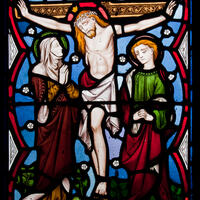
John Stainer had a musical upbringing in Southwark, learning piano and organ at home with his parents and siblings, and serving as a chorister at St Paul’s Cathedral in his youth. He went on to study at St Michael’s College, Tenbury. The college was founded to further the development of Anglican musical worship, playing an important part in the Oxford Movement and the restoration of the choral tradition.
After tenures as organist at St Michael’s College and then at Magdalen College, Oxford, Stainer returned to St Paul’s Cathedral in 1872, when he was appointed organist there. He was instrumental in raising standards at the cathedral, and introduced traditions in the musical liturgy that reflected the theological revolution in the high Anglican church. This included expanding the repertoire to encompass performances of Bach (particularly the Passion oratorios) and Mendelssohn; seeking to make services more engaging for the congregation; and establishing the cathedral choir school.
During the period when he composed The Crucifixion, he bore the significant responsibility of being HM Inspector of Schools for music, in which unpaid role he visited training colleges across England and Wales, and assessed the suitability of the musical tuition there. This seems to underline Stainer’s commitment to raising the national standard of music literacy, with a long-term intention that a more musically capable generation of teachers would in turn benefit pupils across the country.
The Crucifixion reflects these values, offering a format and style that is deeply reverent, yet intended to be accessible and inclusive for the choir and congregation. Stainer scored the work for modest forces, making it straightforward to perform in a local parish setting (as it was for its premiere – at St Marylebone Parish Church, rather than the grander space of St Paul’s), with organ instead of orchestral accompaniment. It was an enormously popular piece during Stainer’s lifetime, becoming a regular part of Anglican worship in countless parishes here in the United Kingdom and across the British Empire – including in a small town near Madras (now Chennai), where the great-grandfather of our conductor, Mark Forkgen, led a performance every year.
While inspired by the dramatic and participatory aspects of Bach’s Passions that made them so powerful, Stainer did not simply compose an English counterpart. The Crucifixion follows an oratorio framework, with the narrative driven by recitatives, arias and choruses, and interspersed by congregational hymns. However, Stainer and his librettist, JW Sparrow-Simpson (1859 – 1952) eschew the scenes of conflict that punctuate the Passion narrative. Instead, the piece serves as an invitation to accompany Christ in his spiritual agony, and focuses more on his inner experiences and emotions. Crucially, the choir takes on Jesus’s voice and perspective – a significant difference compared with the Bach Passions.
The hymns provide the opportunity for the congregation to contemplate the “Divine Humiliation” and their own contrition as the story unfolds. This active participation forms an essential aspect of the work as Stainer originally conceived it. In tonight’s programme, conductor Mark Forkgen and the choir will lead the audience in a rehearsal of the hymn tunes, before the opportunity to sing them during the performance itself.
The piece begins in the garden at Gethsemane, where Jesus is left alone to pray as the disciples fall asleep (‘The Agony’). The commentary sung by the choir seeks to draw a contrast with the congregation’s own efforts to accompany Christ through his Passion.
The air of majesty in ‘Processional to Calvary’, with its grand command to “fling wide the gates”, at first seems incongruous – since by this stage in the narrative, Jesus is an object of scorn, carrying his cross to Golgotha. But it suggests echoes of the triumphal entry into Jerusalem, at the same time articulating the inevitability of scripture being fulfilled through Jesus’s crucifixion, and the glory that will follow his resurrection.
The spectacle of Christ, as God and man, brought low – is considered, first in the congregational hymn dedicated to the Mystery of the Divine Humiliation, and then in the tenor aria ‘The Majesty of the Divine Humiliation’.
The unaccompanied motet ‘God so loved the world’ is a setting of the words spoken by Jesus in John’s Gospel, perfectly distilling the core belief of the Christian faith: Christ’s sacrifice to secure salvation for the world. The tender melody expands to reach new heights with the reiteration of the essential words: “everlasting life”.
Two hymns frame the central moment of the piece: Jesus’s words of forgiveness from the cross, followed by a duet for bass and tenor soloists, reflecting on the significance of his gesture. The first hymn, ‘The Litany of the Passion’, draws the congregation into the crucifixion scene, linking Christ’s suffering with their own atonement, and entreating him to intercede for them. Following the duet, the second hymn, ‘The Mystery of Intercession’ describes Jesus answering this petition.
Jesus’s promise to the Penitent Thief crucified alongside him is scored for the lower voices of the choir, the rich polyphony expressing the wonder of Paradise. The congregational hymn ‘The Adoration of the Crucified’ follows in response.
‘The Appeal of the Crucified’ draws on two liturgical sources. “Is it nothing to you, all you who pass by?” is a verse from the Old Testament Book of Lamentations, historically used as a responsory during Holy Week. The remainder of the text follows the pattern of the ‘Reproaches’, a 9th century antiphonal poem, which contrasts scriptural examples of God’s grace with humanity’s ingratitude; here, Sparrow-Simpson has Jesus decry the loneliness of his own ministry.
Christ’s laments alternate with his compassionate invitation, “O come unto Me”, with which the chorus draws softly to a close. After his dying words from the cross, sung by the lower voices of the choir, the hymn ‘For the love of Jesus’ provides the final reflection, which blends sorrow with affirmation and hope.
List of movements
- Recitative: And they came to a place called Gethsemane (Tenor)
- The Agony (Bass)
- Processional to Calvary
- Fling Wide The Gates
- Recitative: And When They Were Come (Bass)
- The Mystery of the Divine Humiliation
- Recitative: He made himself of no reputation (Bass)
- The Majesty of the Divine Humiliation (Tenor)
- Recitative: And as Moses lifted up the Serpent (Bass)
- God So Loved The World
- Litany of the Passion
- Recitative: Jesus Said, “Father, Forgive Them” (Tenor)
- Duet: So Thou Liftest Thy Divine Petition (Bass, Tenor)
- The Mystery of Intercession
- Recitative: And one of the malefactors
- The Adoration of the Crucified
- Recitative: When Jesus Therefore Saw His Mother
- Recitative: Is it nothing to you (Bass)
- The Appeal of the Crucified
- Recit. & Chorus: After this, Jesus knowing that all things were now accomplished (Tenor)
- For The Love Of Jesus.
Narrator
And they came to a place naméd Gethsemane.
And Jesus saith to his disciples,
“Sit ye here, while I shall pray.”
The Agony
Jesus
Could ye not watch with me, one brief hour?
Could ye not pity my sorest need?
Ah! If ye sleep while the tempests lower,
Surely, My friends, I am ‘lone indeed.
People
Jesu, Lord Jesu,
bowed in bitter anguish,
and bearing all the evil we have done!
Oh, teach us, teach us how to love Thee for Thy love.
Help us to pray, and watch, and mourn with Thee.
Jesus
Could ye not watch with Me one brief hour?
Did ye not say upon Kedron’s slope
ye would not fall into the Tempter’s power?
Did ye not murmur great words of hope?
People
Jesu, Lord Jesu,
bowed in bitter anguish,
and bearing all the evil we have done!
Oh, teach us, teach us how to love Thee for Thy love.
Help us to pray, and watch, and mourn with Thee.
Jesus
Could ye not watch with Me? Even so:
willing in heart, but the flesh is vain.
Back to Mine agony I must go.
Lonely to pray in bitterest pain.
Narrator
And they laid their hands on Him, and took Him,
and led Him away to the high priest.
And the high priest asked Him and said unto Him.
High Priest
Art Thou the Christ, the Son of the Blessed?
Narrator
Jesus said,
Jesus
I am and ye shall see the Son of man sitting on the right hand of power, and coming in the clouds of heaven!
Narrator
Then the high priest rent his clothes, and saith:
High Priest
What need we any further witnesses?
Ye have heard the blasphemy!
Narrator
And they all condemned him, to be guilty of death.
And they bound Jesus and carried Him away
And delivered Him to Pilate.
And Pilate, willing to content the people,
Released Barabbas unto them, and delivered Jesus,
When he had scourged Him, to be crucified.
And the soldiers led Him away.
The Processional to Calvary
People
Fling wide the gates,
For the Saviour waits to tread in His royal way
He has come from above in His power and love, to die on this Passion day.
Fling wide the gates!
The Saviour waits!
Fling wide the gates!
The Saviour waits to tread in His royal way
His cross is the sign of the love divine
His crown is the thorn-wreath of woe
He bears his load on the sorrowful road
And bends ‘neath the burden low.
Fling wide the gates!
He waits! The Saviour waits!
Fling wide the gates,
for the Saviour waits to tread in His royal way.
He has come from above in His power and love,
to die on this Passion day –
To die on this Passion day.
Narrator
How sweet is the grace of his sacred Face?
And lovely beyond compare?
Though weary and worn
With the merciless scorn
Of a world He has come to spare.
The burden of wrong
That earth bears along,
Past evil and evil to be.
All Sins of Man,
Since the world began,
They are laid –
Dear Lord –
On Thee.
People
Then on to the end,
My God and my Friend,
With Thy banner lifted high!
Thou art come from above
In thy power and love,
To endure and suffer and die.
Fling wide the gates!
He waits! The Saviour waits!
Then on to the end,
My God and my Friend,
To suffer, endure, and die.
Narrator
And when they had come to the place called Calvary
There they crucified Him.
And the malefactors – one on the right, and the other on the left.
Hymn – The Mystery of the Divine Humiliation
Choir: Cross of Jesus, Cross of Sorrow,
Where the blood of Christ was shed,
Perfect Man on thee was tortured,
Perfect God on thee has bled.
All: Here the King of all the ages,
Throned in light ere worlds could be,
Robed in mortal flesh is dying,
Crucified by sin for me.
All: O mysterious condescending!
O abandonment sublime!
Very God himself is bearing
All the sufferings of time!
All: Evermore for human failure
By His Passion we can plead;
God has borne all mortal anguish,
Surely He will know our need.
All: This – all human thought surpassing –
This is earth’s most awful hour,
God has taken mortal weakness!
God has laid aside His power!
Choir: From the “Holy, Holy, Holy,
We adore Thee, O most High,”
Down to Earth’s blaspheming voices
And the shout of “Crucify.”
All: Cross of Jesus, Cross of sorrow,
Where the blood of Christ was shed,
Perfect Man on thee was tortured,
Perfect God on thee has bled!
Narrator
He made Himself of no reputation, and took up on Him the form of a servant, and was made in the likeness of men: And being found in fashion as a man, He humbled Himself, and became obedient unto death ev’n the death of Cross.
The Majesty of the Divine Humiliation
Narrator – tenor
King ever glorious!
The dews of death are gath’ring round Thee,
Upon the Cross Thy foes have bound Thee.
Thy strength is gone.
Not in Thy Majesty,
Robed in Heaven’s supremest splendour;
But in weakness and surrender,
Thou hangest here.
Who can be like Thee?
Pilate high in Zion dwelling?
Rome with arms the world compelling?
Proud thou’ they be!
Thou art sublime!
Far more awful in Thy weakness,
More than kingly in Thy meekness,
Thou, Son of God!
Glory, and honour:
Let the world divided and take them;
Crown its monarchs and unmake them -
But Thou — Thou it reign!
Here in abasement
Crownless,
Poor, Disrobed, And bleeding:
There, in glory interceding,
Thou art the King! Thou art the King!
Narrator – bass
And as Moses lifted up the serpent in the widerness, even so must the Son of Man be lifted up: that whosoever believeth in Him, should not perish, but have everlasting life.
People
God so loved the world that He gave His only begotten Son, that who-so believeth in Him should not perish but everlasting life.
For God sent not His Son in to the world to condemn the world;
But that the world through Him might be saved.
Hymn – Litany of the Passion
Choir: Holy Jesu, by thy Passion,
By the woes which none can share,
Bourne in more than kingly fashion
By thy love beyond compare:
All: Crucified I turn to Thee, Son of Mary, pray for me.
Choir: By the treachery and trial,
By the blows and sore distress,
By desertion and denial,
by Thine awful loneliness:
All: Crucified I turn to Thee, Son of Mary, pray for me.
Choir: By thy look so sweet and lowly,
While they smote Thee on the Face,
By thy patience, calm and holy,
In the midst of keen disgrace:
All: Crucified I turn to Thee, Son of Mary, pray for me.
Choir: By the hour of condemnation,
By the blood which trickled down,
When, for us and our salvation,
Thou didst wear the robe and crown:
All: Crucified I turn to Thee, Son of Mary, pray for me.
Choir: By the path of sorrows dreary,
by the Cross, Thy dreadful load,
by the pain, when, faint and weary,
Thou didst sink, upon the road:
All: Crucified I turn to Thee, Son of Mary, pray for me.
Choir: By the Spirit which could render
Love for hate and good for ill,
By the mercy, sweet and tender,
Poured upon Thy murderers still:
All: Crucified I turn to Thee, Son of Mary, pray for me.
Narrator
Jesus said,
Jesus
“Father, forgive them, for they know not what they do.”
Duet
So Thou liftest Thy divine petition,
Pierc’d with cruel anguish through and through
So Thou grievest o’er our lost condition,
Pleading, “Ah, they know not what they do.”
Oh ‘twas love, in love’s divinest feature,
Passing o’er that dark and murd’rous blot,
Finding e’en for each low fallen creature,
Tho’ they slay Thee, one redeeming spot.
Yes! And still Thy patient Heart is yearning
With a love that mortal scarce can bear.
Thou in pity deep, divine, and burning
Liftest e’en for me Thy mighty prayer.
So Thou pleadest, e’en for my transgression,
Bidding me look up, and trust, and live;
So Thou mumurest Thine intercession,
Bidding me look up, and trust, and live;
So Thou pleadest,
Yea, he knew not,
For My sake forgive.
Hymn – The Mystery of Intercession
Choir: Jesus, the Crucified prays for me,
While He is nailed to the shameful tree,
Scorned and forsaken, derided and curst,
See how His enemies do their worst!
Yet, in the midst of the torture and shame,
Jesus, the Crucified, breathes my name!
All: Wonder of wonders, oh! How can it be?
Jesus, the Crucified, prays for me!
Choir: Lord, I have left Thee, I have denied,
Followed the world in my selfish pride;
Lord, I have joined in the hateful cry,
Slay Him, away with Him, crucify.
Lord, I have done it, oh! ask me not how;
Woven the thorns for Thy tortured Brow;
All: Yet in His pity, so boundless and free,
Jesus, the Crucified, prays for me!
Choir: Though thou hast left Me and wandered away,
Chosen the darkness instead of the day;
Though thou art covered with many a stain,
Though thou hast wounded Me oft and again;
Though thou hast followed thy wayward will;
Yet, in My pity, I love thee still.
All: Wonder of wonders it ever must be!
Jesus, the Crucified, prays for me.
Choir: Jesus is dying in agony sore,
Jesus is suffering more and more,
Jesus is bowed with the eight of His woe,
Jesus is faint with each bitter throe,
Jesus is bearing it all in my stead,
Pity Incarnate for me has bled;
All: Wonder of wonders it ever must be!
Jesus, the Crucified, prays for me.
Narrator
And one of the malefactors which were hanged railed on Him saying:
First Malefactor
If Thou be the Christ save thyself and us
Narrator
But the other answering rebuked him, saying:
Second Malefactor
Dost not thou fear God seeing thou art in the same condemnation?
And we indeed justly; for we receive the due reward for our deeds:
but this man has done nothing amiss.
Narrator
And he said unto Jesus:
Second Malefactor
Lord, remember me when Thou comest into Thy Kingdom.
Narrator
And Jesus said unto him:
Jesus
Verily I say to thee, today shalt thou be with Me in Paradise.
Hymn – The Adoration of the Crucified
Choir: I Adore Thee, I adore Thee!
Glorious ere the world began;
Yet more wonderful Thou shinest,
Though divive, yet still divinest
In Thy dying love for man.
All: I Adore Thee, I adore Thee!
Thankful at Thy feet to be;
I have heard Thy accent thrilling,
Lo! I come, for Thou art willing
Me to pardon, even me.
All: I Adore Thee, I adore Thee!
Born of woman, yet Divine:
Stained with sins I kneel before Thee,
Sweetest Jesu, I implore Thee,
Make me ever only Thine.
Narrator
When Jesus therefore saw His Mother
and the disciples standing by, whom he loved;
He saith unto His Mother:
Jesus
Woman! Behold thy son.
Narrator
Then saith He to the disciples:
Jesus
Behold thy mother!
Narrator
There was darkness over all the earth.
And at the ninth hour Jesus cried with a loud voice, saying:
Jesus
My God! My God!
Why hast Thou forsaken Me?
Jesus
Is it nothing to you, all ye that pass by?
Behold, and see if there be any sorrow like unto My sorrow.
Which is done unto Me,
Wherein the Lord hath afflicted Me in the day of His fierce anger.
The Appeal of the Crucified
People
From the Throne of His Cross, the King of grief
Cries out to a world of unbelief:
Oh men and women, afar and nigh,
Is it nothing to you, all ye that pass by?
I laid My eternal power aside, I came from the Home of the Glorified,
A babe in the lowly cave to lie.
Is it nothing to you, all ye that pass by?
I wept for the sorrows and pains of men,
I healed them and helped them and loved them,
But then, but then, they shouted against Me,
“Crucify! Crucify!”
Is it nothing to you?
Behold Me and see: pierced thro’ and thro’ with countless sorrows,
and all is for you;
For you I suffer, for you I die.
Is it nothing to you, all ye that pass by?
Oh! men and women your deeds of shame,
Your sins without reason and number and name,
I bear them all on the Cross on high,
Is it nothing to you?
Is it nothing to you that I bow My Head?
And nothing to you that My Blood is shed?
Oh! Perishing souls to you I cry,
Is it nothing to you?
O come unto Me, by the woes I have borne,
By the dreadful scourge, and the crown of thorns,
By these I implore you to hear My cry,
Is it nothing to you?
O come unto Me!
This awful price,
Redemption’s tremendous sacrifice,
Is paid for you.
Oh! Why will ye die?
O come unto Me!
For why will ye die?
Come to Me.
Narrator
After this, Jesus, knowing that all things
were now accomplished, saith:
Jesus
I thirst.
Narrator
When Jesus had received the vinegar, he saith:
Jesus
It is finished! Father, into Thy hands I commend My Spirit.
Narrator
And He bowed His head, and gave up the ghost.
Hymn – For the love of Jesus
Choir: All for Jesus – all for Jesus,
This our song shall ever be;
For we have no hope, nor Saviour,
If we have not hope in Thee.
All: All for Jesus Thou wilt give us
Strength to serve Thee, hour by hour;
None can move us from Thy presence,
While we trust Thy love and power.
All: All for Jesus – at Thine altar
Thou wilt give us sweet content;
There, dear Lord, we shall receive Thee
In the solemn Sacrament.
Choir: All for Jesus – Thou hast loved us;
All for Jesus – Thou hast died;
All for Jesus – Thou art with us;
All for Jesus Crucified.
All: All for Jesus – All for Jesus!
This the Church’s song must be;
Till, at last, her sons are gathered
One in love and one in Thee. Amen.