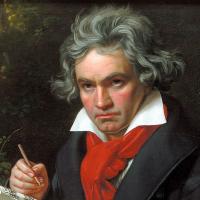
Beethoven composed his Mass in C in 1807 as a commission for Prince Nikolaus Esterházy II. It was the prince’s custom to commission a Mass to celebrate his wife the Princess Maria’s nameday each year. Haydn, Beethoven’s tutor in earlier years, had written six of these celebratory Masses up to 1802 by when his health had failed and the commissions passed to Johann Hummel. The prince turned to Beethoven in 1807 after meeting him in the Viennese Theatre where the prince was patron and Beethoven was musical director, working on his opera Fidelio. Beethoven worked on the Mass that summer, while planning his Fifth Symphony.
For Beethoven, who was struggling with family and financial difficulties, the prospect of commissions from one of Europe’s most prominent patrons was a magnificent opportunity and lifeline for the future. But it was not to be. The prince did not like the Mass, and wrote to a friend “it is unbearably ridiculous and detestable… I am ashamed”. The relationship was broken petulantly on both sides and Beethoven did not work for the prince again. Nor did he attempt another setting of the Mass for some ten years.
It is not clear what upset the prince. Beethoven had wished to set the text “in a manner in which it has rarely been treated” giving full weight to the meaning and sanctity of each line. It may have been that in contrast with Haydn’s cheerful and colourful settings parts of the Mass proved too stern for a family celebration.
The Mass in C is deferential to the liturgy but with untraditional arrangement and scoring that his audience may have found disturbing. The Kyrie begins with unaccompanied bass voices, moving to a climax before the two main movements, the Gloria and the Credo. Some particularly profound passages are delivered in unison, sometimes unaccompanied or, as in the Sanctus, accompanied by timpani only. Fugal crescendos underline the statements of belief in the Credo. Overall, the Mass follows a symphonic progression of keys from the traditional C major and returning to it. This circular journey closes with Dona Nobis Pacem completed movingly by the return of the theme of the opening Kyrie.
Initially disregarded because of its history and eclipsed for most of two centuries by his towering Missa Solemnis of 1816, the Mass in C has only recently come to be recognised as one of Beethoven’s most masterly works. It is his personal testimony to spirituality and peace contrasted with the force of belief and commitment.
Text and Translation
Kyrie
|
Kyrie eleison. |
Lord, have mercy upon us. |
Gloria
|
Gloria in excelsis Deo, Domine Fili unigenite, Jesu Christe, Qui tollis peccata mundi, Quoniam tu solus sanctus, |
Glory be to God on high, O Lord the only-begotten Son Jesus Christ, Who takest away the sins of the world, For Thou alone art holy, |
Credo
|
Credo in unum Deum, patrem omnipotentem, Et in unum Dominum Jesum Christum, Et incarnatus est de Spiritu Sancto ex Maria Virgine, et homo factus est. Et resurrexit tertia die, |
I believe in one God, the Father Almighty, And in one Lord Jesus Christ, And was incarnate by the Holy Ghost of the Virgin Mary, and was made man. And the third day he rose again |
|
|
Et in Spiritum Sanctum, Dominum |
And [I believe] in the Holy Ghost, the Lord |
Sanctus
|
Sanctus, Sanctus, Sanctus |
Holy, Holy, Holy, |
Benedictus
|
Benedictus qui venit in |
Blessed is He Who cometh in the |
Agnus Dei
|
Agnus Dei, qui tollis |
Lamb of God, Who takest away the sins of the world, |
Composer: Beethoven Wiki Link: http://en.wikipedia.org/wiki/Mass_in_C_major_%28Beethoven%29 Title of Musical Work: Mass in C